Off-plan properties dominate Dubai’s market, with this segment accounting for 23,457 transactions worth AED 41.58 billion in Q3 2026 alone. Operational discipline, transparency, and regulatory oversight remain key drivers behind achieving this number.
Nonetheless, a number of investors still face losses. This isn’t due to the legal structure, but to a lack of proper evaluation. Buying early also means trusting a developer with your money for years, so asking for proof rather than relying on promises will save your deposit from going into the wrong hands. This guide reveals how to evaluate an off-plan developer in Dubai before you commit financially.
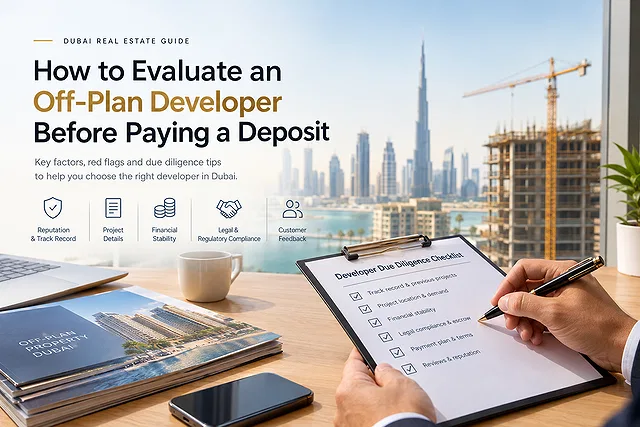
A Step-by-Step Guide for Evaluating an Off Plan Developer
Step 1: Verify Registration of the Developer & Project
Begin your evaluation journey through the law, as Dubai Law No. 8 of 2007 emphasizes mandatory registration and licensing of a developer who sells units in the off-plan stage. Confirm the project is legally backed by the DLD before relying on the brand name.
Afterwards, check the project’s registration with the Dubai Land Department that runs a Project Status Enquiry in the Dubai REST application. It shows:
- Developer details
- Completion status
- Inspection updates
- Escrow information
You can simply enter the project name, project number, or plot number to find the details. In case the project does not appear, treat it as a red flag and disqualify the developer from your list.
Advertisements and property listings need checking as well, as the Madmoun system by DLD offers another effective way to safeguard yourself from real estate fraud. The system is managed by the RERA through the Trakheesi system and generates a mandatory QR code for every authorized property listing. Scan the code and compare the details yourself with what the salesperson told you.
Quick Registration Checking Tips
- The developer’s license and registration number on DLD
- The broker’s permit through DLD’s Trakheesi system
- The Madmoun QR code on the advertisement
- The project’s registration number and construction percentage.
Step 2 – Verify the Escrow Account Before Transferring Money
The escrow account remains one of the strongest safety nets, as Kayrouz and Associates reported an estimated 78% reduction in developer fraud following the execution of this system. Dubai’s regulatory bodies mandate that every off-plan payment go into a project-specific escrow account.
The account opens after the project’s name, and it is illegal to use one escrow for another project, meaning each project needs its own account. Buyers are also forbidden to rely on salesperson-sent details via Email or WhatsApp.
The Project Status Enquiry always shows details regarding the escrow account. Additionally, escrow links your money to building progress, and buyer funds should follow construction. Walking away is the best option if a developer fails to provide escrow details in writing.
Escrow Check in Three Steps
- Search the project on DLD’s Project Status Enquiry.
- Carefully match the escrow account name and number with the details you have.
- Verify whether the escrow account is opened with a registered UAE bank.
Step 3 – Study the Developer’s Delivery Track Record
A developer’s history is the best guide to its future pipeline. Begin looking for completed projects by the developer before focusing on the huge number of consistent launches.
The handover pattern also matters, as one delay is not disqualifying, but repeated delays across developments surface a clear alert. In some cases, buyers often manage a delay of six to twelve months, but a multi-year delay disrupts the rental and resale plan completely.
Visit a Completed Building
If feasible, off-plan buyers must personally visit the building delivered by the developer earlier to check:
- The common areas
- Status of maintenance
- Operational efficiency of lifts and other amenities.
Communicate with residents living in the building and ask them about any open snagging issues, service charges, and build quality. Buyers living overseas can ask for the most recent photos, snagging reports, and leasing data in completed buildings.
What to Evaluate?
| Checks | What to Inquire? |
|---|---|
| Finished Projects | How many buildings have been handed over? |
| Promised vs. Actual Completion | Was the project delivered on the targeted time? |
| Build Quality | How does the building meet its maintenance standards? |
| Residents’ Feedback | What do owners say about the building and developer? |
| After-Sales Care | How does the developer manage concerns after completion? |
| Neighborhood Feel | How convenient is the surrounding landscape in fulfilling daily needs and commute? |

Step 4 – Assess Financial Strength and Contractor
Funding also matters for projects under construction in Dubai. Projects are often completed on time by the developers who rely on large institutional or private capital instead of sales income. This means that the capital structure, equity base, and parent company must be evaluated on a priority basis. Off-plan buyers must ask for the main contractor and whether the parent company has other projects under way.
New developers in Dubai are not all unsafe, but an in-depth assessment allows buyers to compare the percentage of construction backed by equity and buyer payments. Many developers in Dubai function through extensive networks of consultants, engineers, contractors, and project managers.
So, checking for the construction contractor also matters when evaluating off-plan buyers before paying the initial deposit. A new developer with an established contractor results in reduced execution risk, while a developer with an unknown contractor requires more caution even if the brochure looks appealing.
Dubai’s leading developers usually partner with recognized contracting firms and consultants, and this consistent approach automatically strengthens trust and operational efficiency.
Step 5 – Read the Reservation Form and SPA
A refundable deposit still carries conditions, so it is better to check the unit, price, and deposit amount before paying. Ask for any verbal promise in writing and consider refund terms carefully.
The Sales and Purchase Agreement (SPA) is the document that binds you, advising buyers to read the clauses closely, including:
- Service charges, unit size, and parking conditions
- Default and cancellation terms
- Handover date and grace period
- Payback conditions and delay penalties
After signing, the DLD requests buyers to confirm provisional registration of their initial sales within 90 days from the day of signing the SPA. Keeping your Oqood Certificate safely and reviewing the provisional registration from a lawyer is worth the cost.
Step 6 – Understand the Payment Plan and Evaluate the Real Cost
Risks associated with off-plan purchase are often concealed in the payment plans. A payment plan with large post-handover schedules indicates the developer’s confidence in its own financial stability. Meanwhile, a front-loaded plan shifts risks more toward the buyer.
Also, look beyond the first installment and compare the booking amount, construction-linked milestone payments, and balance due by handover. Buyers purchasing with a mortgage should also factor in related fees and costs, while overseas buyers must plan for currency swings.
Before paying a deposit, ask for full costs that include;
- Service charges
- DLD fee
- Mortgage costs (if any)
- Administrative/ trustee fee
- Agent fee

Critical Risk Factors to Consider Before Paying a Deposit
Buyers are suggested to check for several real estate warning signs before finalizing a deal;
| Risk Factor | Why It Matters |
|---|---|
| Project not found on DLD | It may not be cleared for sale |
| Pressure to pay immediately | It limits comprehensive checks |
| Bank details sent by chat | Your money may bypass escrow |
| Consistent delay in handovers | Signals weak planning or developer’s financial instability |
| Unverified contractor | Raises the risk of delays and poor build quality |
Closing In
Dubai is expecting completion of about 56,600 homes by the end of 2026, moving the market towards a balanced phase. A rise in supply automatically points to diversity in choosing what aligns with actual budgets, buying goals, and lifestyle preferences. And strong delivery records also separate established developers from weak ones or new entrants.
Dubai’s well-regulated property market protects both buyers and developers with several tools established for enhanced transparency and clear evaluation. Developers with a clear and bold record earn an advantage over those with late deliveries, unrecognized contractors, and high dependence on buyer payments for construction.
FAQs
Is it risky to invest in a project by a new developer in Dubai?
New developers in Dubai often perform well, but the whole off-plan success hinges on a verified escrow account, recognized contractor, funding structure, and building progress.
Is provisional registration of an off-plan purchase mandatory?
Yes, a provisional registration is mandatory for off-plan properties for sale in Dubai to protect the purchase through an Oqood certificate and legally record it until the title deed is issued.
Who regulates off-plan developers in Dubai?
The DLD and the Real Estate Regulatory Authority (RERA) are two key bodies, regulating developers, project registration, and escrow accounts.
What to check when evaluating a Dubai developer’s track record?
Run checks through the developer’s completed projects in the past, after-sales support, build quality, completion timelines, and feedback from current residents.
Is the initial deposit refundable?
The refund only depends on the terms and conditions delineated in the Sales and Purchase Agreement, suggesting that buyers read the document carefully before paying a deposit.


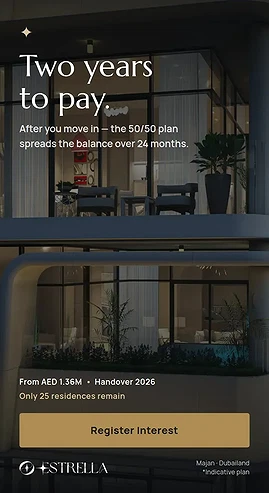





 Dubai Maritime City