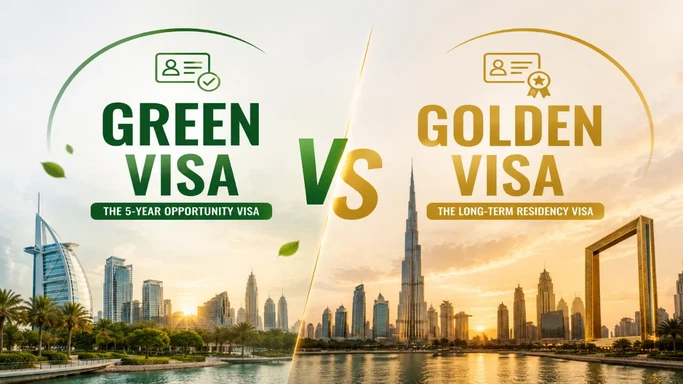
The UAE offers two long-term visa options that are often misunderstood: Green Visa and Golden Visa. Both are self-sponsored residency grants, but they're designed for different profiles. The Golden Visa is based on investment in capital, usually property or business investment, and the Green Visa is based on employment, freelancing, or business investment at a lower level of entry.
The Dubai visa comparison guide goes beyond the marketing language of each visa to let you know basic facts. This guide helps you sort out the jargon behind each type to help you match the visa with your finances today.
What is the Green Visa
The Green Visa is a self-sponsored residency visa program with 5-year validity. This visa is for:
- Freelancers
- Skilled employees
- Business owner/partners
Applicants for this visa do not need to find a sponsor in order to obtain the visa. This gives the holder greater flexibility to change jobs or have multiple clients without having to reapply for the visa every time. The entry threshold is lower than the Golden Visa's investment routes, making it a realistic option for professionals and business owners who are not yet holding AED 2 million or more in qualifying assets. It is meant to be a temporary option for many applicants, as a stepping stone to the Golden Visa.
What is Golden Visa
The Golden Visa is a 10-year renewable, non-sponsored residency visa. There are several ways to obtain this visa, such as
- AED 2 million or more in real estate investment.
- Ownership of a business.
- Outstanding achievements in the sciences, medicine, arts, and other specialised fields.
- Exceptional academic performance.
Holders may sponsor their spouse, children and parents, and in most instances they can also sponsor domestic staff. Not bound to a contract, holders can move to other employers, launch a business, or move to other countries in the UAE for long periods without losing their residency. One of the key benefits of independence over regular employment visas is this lack of employer dependence.
Green Visa vs Golden Visa: Head-to-Head Comparison
The following table summarises the key differences and provides explanations for each of them.
| Factor | Green Visa | Golden Visa |
|---|---|---|
| Duration | 5 years, renewable | 10 years, renewable |
| Sponsorship | Self-sponsored | Self-sponsored |
| Core eligibility | Freelancers, skilled employees, business owners | Property (AED 2M+), business, talent |
| Family sponsorship | Spouse and children | Spouse, children, parents |
| Minimum salary (employment route) | AED 15,000/month | Not applicable |
| Grace period if visa lapses | 3 months | 6 months |
Green Visa vs Golden Visa: Key Differences for Investors
Duration and Renewal
A 10-year term means fewer renewal cycles than the Green Visa's 5-year term, which matters for anyone who would rather not repeat paperwork every few years. Renewal for either visa requires re-verifying that you still meet the qualifying criteria, whether that's the property, the business, or the role.
Sponsorship and Family
Both visas are self-sponsored, so neither depends on an employer staying in the picture. The Golden Visa's ability to include parents is the most meaningful difference for anyone relocating an entire household, not just a spouse and children.
Both routes typically require attested marriage and birth certificates for dependents, and processing times can vary depending on where those documents were originally issued.
Entry Threshold
This is the section that answers the question most investors actually have: which one can I get right now? The Golden Visa's property and business routes are capital-based, while the Green Visa's main route is income or role-based, with an AED 15,000 monthly salary threshold for employees.
Costs and Renewal
Both visas involve similar categories of cost: an application fee, a medical fitness test, and an Emirates ID issuance fee, typically totalling a few thousand dirhams per applicant once dependents are included. The Golden Visa's real estate route also involves standard property transaction costs, since the qualifying asset has to be purchased and registered first, including DLD transfer fees and any agent commission on the sale.
- Golden Visa: application, medical test, and Emirates ID fees apply per applicant and dependent.
- Green Visa: similar fee categories apply, generally at a lower overall cost given the shorter validity period.
- Selling the qualifying property before renewal is the most common trigger for Golden Visa cancellation under the real estate route.
- Renewal for both visas requires re-submitting proof of eligibility, whether that's an updated title deed, business licence, or salary certificate.
What Happens If Your Visa Lapses
The Golden Visa allows visa holders a 6-month grace period when the visa expires, while the Green Visa only provides a 3-month grace period. Holding permits are usually granted to holders to continue living in the UAE during this time period.
Put simply, the Golden Visa suits capital-backed investors who have already deployed significant funds, while the Green Visa suits income- or business-backed applicants building toward that position.
Golden Visa Through Property Investment
The real estate path is the most up-to-date and applicable path for property investors. The bottom line is that a minimum of AED 2 million or more in qualifying property is the minimum requirement, but the specifics about what qualifies are just as important as the actual amount.
Most applicants think that the rules are straightforward until they get to the details of owning a unit in a mortgage or owning an investment property in joint ownership, so it's worth checking each of these cases before taking anything for granted.
- Property must be completed or an eligible off-plan unit from a developer approved by the Dubai Land Department.
- Mortgaged property may still qualify, provided the paid-up value, not the total purchase price, meets the AED 2 million threshold.
- Jointly owned property, such as between spouses, can qualify if each owner's individual share meets the minimum threshold on its own.
- Co-investment structures involving multiple unrelated investors are assessed on each investor's proportional share, so a group purchase does not automatically qualify every participant.
- Multiple smaller properties can sometimes be combined to reach the AED 2 million threshold, though this depends on how the properties are registered and should be confirmed before purchase.
A quick way to see how this plays out: an investor holding a paid-up AED 2 million apartment qualifies for the Golden Visa today. The Green Visa would be the first entry point for employees with an AED 15,000 monthly income without any property, whereas the Golden Visa would be the first step for those who are on the path to secure their capital. The route between the two is not uncommon, and many applicants view the Green Visa as a means to a Golden Visa rather than a separate end goal.

Which UAE Visa is Best for Different Investor Profiles?
The Golden Visa is for those who already have AED 2 Million or more in qualifying real estate. The Green Visa is an easier, quicker step for a business owner or freelancer who is still accumulating to that mark without going to the trouble of committing capital in the initial stages. A salaried professional without property or business ownership, but earning above the AED 15,000 monthly threshold, fits the Green Visa's employment route most naturally.
A retiree or passive investor relying on rental income from a smaller property, one that falls short of AED 2 million, may also find the Green Visa's lower barrier more immediately workable while the property portfolio grows. None of these routes is fixed for life. Moving from a Green Visa to a Golden Visa later, once your capital position qualifies, is a normal and common transition, and many investors plan for it from the outset.
Summary
Neither visa is objectively better than the other. The right choice comes down to your current capital position, not a general ranking between the two. If you already hold AED 2 million or more in qualifying property or business assets, the Golden Visa offers a longer term and broader family sponsorship. If you're still building toward that threshold, the Green Visa is a practical, accessible route in the meantime, with a clear path to upgrade once your position changes.
FAQs
Can I get a Golden Visa without buying property?
Yes. Business ownership, specialised talent, and outstanding academic performance are all separate Golden Visa routes that do not require real estate investment.
Does off-plan property qualify for the Golden Visa?
Yes, provided the unit is from a developer approved by the Dubai Land Department, and the paid-up value meets the AED 2 million threshold.
Can I switch from a Green Visa to a Golden Visa later?
Yes. This is a common transition once your capital position, business ownership, or professional profile meets the Golden Visa's eligibility criteria.
What happens to my Golden Visa if I sell the property?
Selling the qualifying property without replacing it with another eligible investment is the most common reason a real-estate-based Golden Visa gets revoked.
Are there any work permits available for Green Visa applicants?
Yes, the UAE Green Visa functions as a self-sponsored 5-year residency, but the specific type of work authorisation you need depends on your professional category:






 Meydan